Most product ideas look promising at first. The concept makes sense. Early designs look impressive. Teams begin discussing launch plans, timelines, and market opportunities.
Then development begins.
A prototype behaves differently during testing. Manufacturing complexity increases. Customers interact with the product in unexpected ways. Engineering revisions start affecting timelines, costs, and scalability.
This is where product development becomes far more difficult than most companies expect.
Because successful products are no longer judged only by innovation.
They are judged by how well they scale.
Can the product perform reliably in real-world conditions?
Can manufacturing support long-term production efficiently?
Can engineering decisions stand up without later redesigns?
Those questions are shaping modern product development in 2026 far more than feature lists or launch speed.
At Innovative Design Products, companies are investing earlier in validation, rapid prototyping, manufacturability planning, and usability refinement because solving engineering problems during development is far easier than solving them after production begins.
Why scalable product development is becoming harder
Building a product today involves far more moving parts than it did a few years ago.
Customer expectations evolve quickly. Hardware and software systems are becoming more connected. Supply chains remain unpredictable. Manufacturing costs continue to fluctuate.
As products become more advanced, small engineering decisions begin creating larger downstream effects.
Changing one component may impact:
- Assembly efficiency
- Thermal behavior
- Sourcing timelines
- Production consistency
- Long-term reliability
This is why experienced product teams spend significant time validating assumptions before scaling production.
Once manufacturing begins, even small redesigns can become expensive very quickly.
The prototype stage completely changes the conversation.
There is a major difference between reviewing a design and physically interacting with a product.
A product may look intuitive during development reviews but feel awkward during actual use. Internal layouts that appear efficient digitally may create overheating or assembly concerns during testing.
Even requested features can sometimes complicate usability rather than improve it.
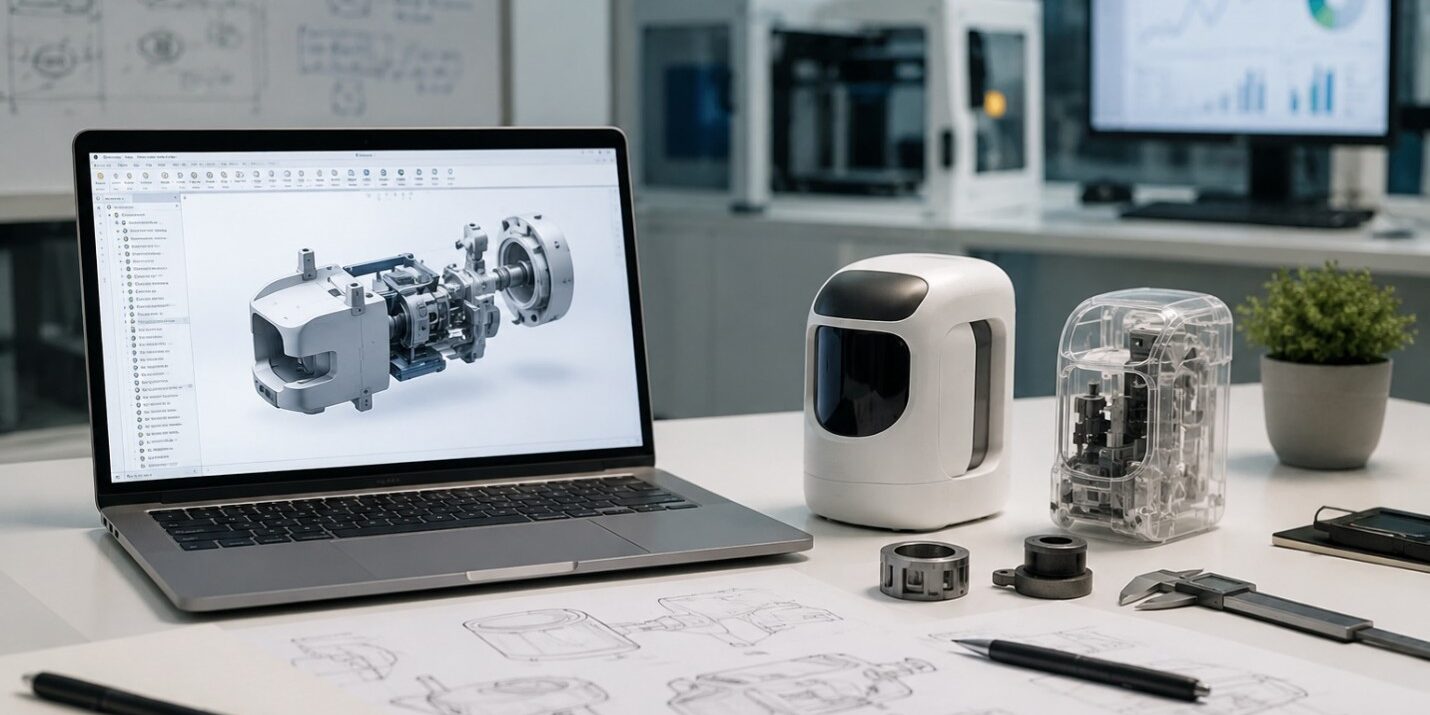
This is why prototyping remains one of the most valuable stages of modern product design and development.
At IDP, prototypes are treated as engineering learning tools, not presentation pieces. Physical interaction reveals issues that are difficult to detect during early concept discussions.
Can the product withstand repeated use?
Will assembly remain efficient at scale?
Can users understand the product naturally?
Will the design remain consistent during production?
Those answers determine whether a product can scale successfully beyond early development.
Why do products become harder to scale over time
A product that works well in limited quantities may become much more difficult to produce as production volume increases.
Supplier inconsistencies appear. Assembly tolerances tighten. Manufacturing variability starts affecting reliability and profitability.
This is where scalable product creation requires much more than strong concepts or attractive design.
It requires disciplined engineering decisions early in the process.
The strongest product teams are now evaluating manufacturability, usability, reliability, and long-term production support much earlier than before.
That shift is becoming a major competitive advantage in 2026.
AI is accelerating development, not replacing engineering expertise.
AI-assisted engineering tools are significantly speeding up product workflows.
Teams can now:
- Run simulations faster
- Optimize CAD iterations
- Identify inconsistencies earlier
- Shorten testing cycles
- Improve design efficiency
That acceleration creates enormous value during development.
But AI still cannot fully account for:
- Customer behavior
- Manufacturing pressure
- Supplier constraints
- Usability trade-offs
- Assembly complexity
- Long-term product reliability
Those decisions still depend heavily on engineering experience and practical product knowledge.
At IDP, AI supports development workflows, while experienced engineers continue to guide decisions on whether products can realistically scale beyond prototyping.
Validation is becoming more important than speed.
Many companies still move too quickly from concept to development.
That creates unnecessary risk.
In 2026, stronger product teams are validating much earlier before committing heavily to production.
That includes evaluating:
- Customer expectations
- Pricing tolerance
- Usability behavior
- Manufacturing feasibility
- Scalability requirements
Early validation may slow initial momentum slightly, but it prevents much larger engineering and production problems later.
This is where experienced product design and development partners create measurable value by identifying hidden risks before they become expensive revisions or production delays.
Product development no longer follows a straight path.
Successful products rarely emerge through a perfectly linear process.
Development usually involves continuous refinement as testing reveals new engineering, usability, or manufacturing challenges.
Materials change.
Designs evolve.
Usability improves.
Production workflows adjust.
That iteration is not a sign of failure.
It is usually a sign that product creation is working correctly.
Scalable products improve through repeated refinement long before manufacturing reaches full scale.
Manufacturing changes how products are engineered.
One of the biggest shifts happening in modern product design & development is the growing focus on manufacturability during early engineering stages.
A prototype may function perfectly while still being difficult or expensive to produce consistently at scale.
Once production begins, engineering decisions start affecting:
- Manufacturing speed
- Assembly efficiency
- Supplier coordination
- Product consistency
- Margins
- Long-term reliability
That is why experienced teams evaluate manufacturability during development itself rather than waiting until production begins.
Late-stage redesigns increase costs, delay timelines, and create avoidable production issues.
What successful product development looks like in 2026
The strongest companies today are not focused only on launching products quickly.
They are focused on building products that remain reliable, manufacturable, scalable, and commercially sustainable long after launch.
That requires:
- Early validation
- Continuous testing
- Rapid prototyping
- Usability refinement
- Manufacturing awareness
- Disciplined engineering decisions
The hardest part of product creation is rarely coming up with the idea.
The real challenge is building something that can scale reliably once manufacturing, usability, performance, and production realities begin influencing the process.
In 2026, successful products are increasingly defined by how well they perform during iteration, validation, manufacturing, and long-term scalability.
At Innovative Design Products, we work with companies developing connected devices, engineered systems, IoT products, medical technologies, and next-generation innovations that require products engineered for scalability from the beginning. Our expertise extends to medical product development and partnering as a medical device engineering firm, helping organizations transform complex concepts into compliant, manufacturable, and market-ready solutions.
If you are developing a product that needs to move beyond concept renderings and become commercially scalable in the real world, connect with the IDP team to discuss your product creation goals. Our experts support every stage of development, from idea generation and product concept creation to market research, business analysis, and building a strong product design & development plan. With proven strategies, experienced product design & development teams, and efficient development cycles, we help businesses create minimum viable products, refine product management processes, gather customer feedback, and successfully bring a product to market.
Visit us or contact Jennifer Rivkind at 949-748-1902.